Which CRM Is Best for Your Charity? Comparing the Leading CRM Systems for UK Charities in 2026
-
03/08/2026
- 9 minutes Read
Choosing the right CRM can have a major impact on fundraising, service delivery, reporting and how effectively your charity uses its data.
We compare the leading CRM systems used by UK charities including;
Blackbaud Raiser’s Edge NXT, Salesforce, Microsoft Dynamics 365, Donorfy, Beacon, Access Charity CRM, Charitylog and CiviCRM
Understand where each fits, their strengths and limitations, and what charities should consider before making a long-term investment.
Choosing a CRM is one of the biggest technology decisions a charity can make.
Get it right and your CRM can give you a clearer view of supporters, improve fundraising, reduce administration and provide leadership with better information.
Get it wrong and you can spend years dealing with duplicate records, spreadsheets, difficult integrations and a system that staff gradually stop using.
The difficulty is that there isn’t one “best charity CRM”.
A small charity managing 2,000 supporters has very different requirements from a national organisation with hundreds of employees, multiple fundraising teams and millions of supporter records.
A charity primarily managing beneficiaries and services also has very different requirements from one focused on fundraising.
That’s why we think the better question is:
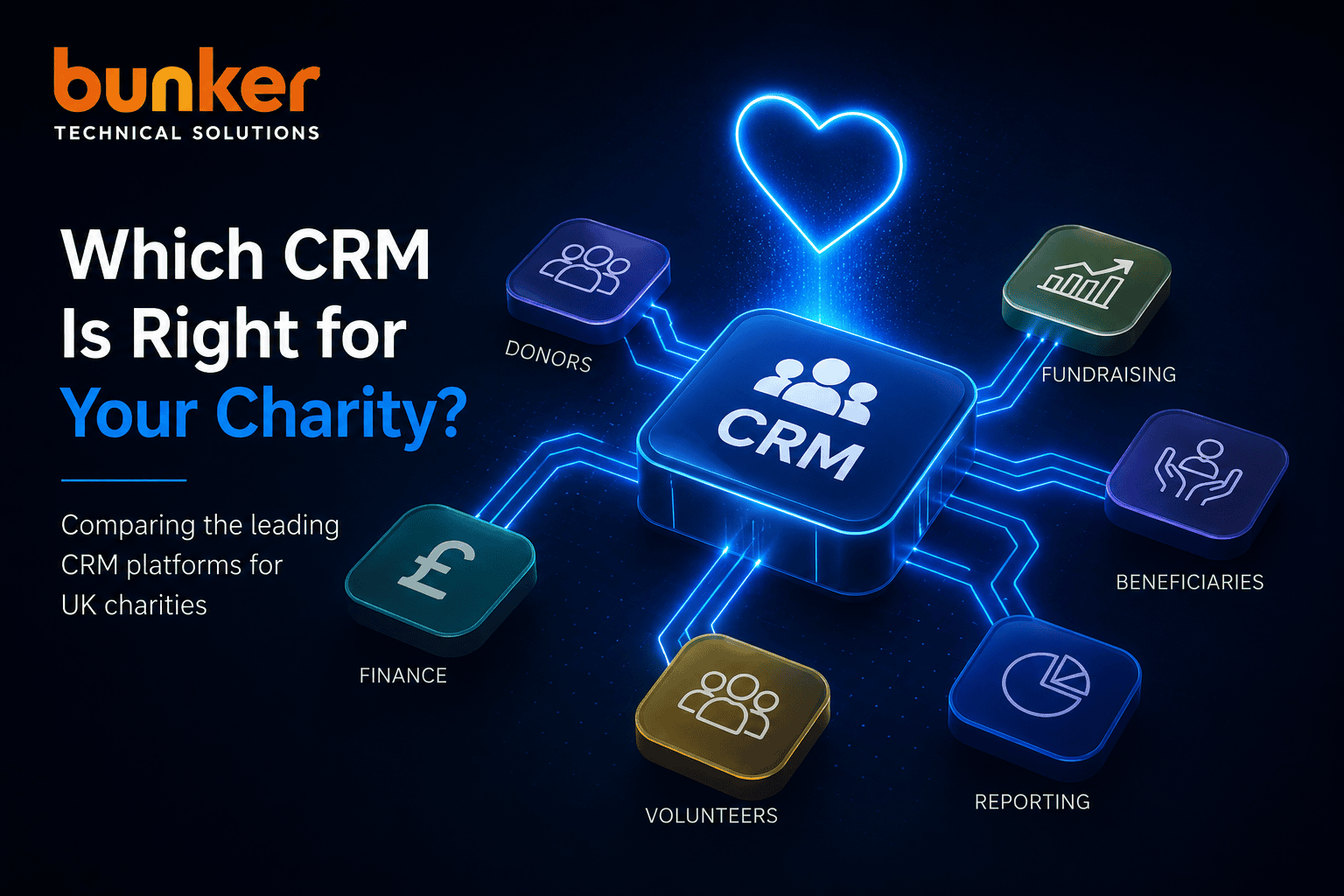
Which CRM is right for your charity?
Over the next few weeks, Bunker will be taking a detailed look at some of the most widely used CRM platforms in the UK charity sector—including Blackbaud Raiser’s Edge NXT, Salesforce, Microsoft Dynamics 365, Donorfy, Beacon, Access Charity CRM, Charitylog and CiviCRM.
We’ll look beyond feature lists to understand what each platform is genuinely good at, where the limitations are and what charities should consider before making a long-term investment.
But first, let’s look at the market.
Why Do Charities Need a CRM?
At its simplest, a CRM gives your charity one place to manage the relationships that matter to your organisation.
Depending on the charity, that might include:
- Individual donors
- Corporate supporters
- Major donors
- Volunteers
- Members
- Beneficiaries
- Grant-making organisations
- Partners and stakeholders
But modern charity CRMs can do considerably more.
They can manage donations and Gift Aid, track fundraising campaigns, record interactions, automate communications, manage events, support beneficiary services and provide leadership teams with reporting and insight.
The challenge is that not every CRM does all of those things equally well.
And that’s where CRM selection becomes difficult.
What CRM Systems Do UK Charities Use?
There are dozens of options, but several platforms appear repeatedly across the UK charity sector.
Blackbaud Raiser’s Edge NXT
Blackbaud Raiser’s Edge NXT is one of the best-known fundraising CRMs in the charity sector.
Its strength is fundraising.
It provides tools for managing donors, gifts, campaigns, supporter relationships and fundraising performance.
For established charities with mature fundraising teams, that depth can be extremely valuable.
However, charities considering Raiser’s Edge also need to think about implementation, integrations, administration and the overall cost of operating the platform—not simply the software itself.
Likely best fit: Established and larger charities with sophisticated fundraising requirements.
Salesforce Nonprofit Cloud
Salesforce for nonprofits takes a different approach.
Rather than being primarily a fundraising database, Salesforce provides a highly configurable platform that can potentially support fundraising, programmes, case management, volunteering and other organisational processes.
That flexibility is one of its greatest strengths.
It’s also one of its challenges.
A well-designed Salesforce environment can be extremely powerful. A heavily customised environment without clear ownership can become difficult and expensive to maintain.
Likely best fit: Larger or more complex charities that require significant flexibility and have the resources to manage it properly.
Microsoft Dynamics 365
Microsoft Dynamics 365 for nonprofits is particularly interesting for charities already heavily invested in Microsoft.
Dynamics can work alongside Microsoft 365, Power BI, Power Automate and Power Apps to create a much broader technology platform.
That can open opportunities around automation, reporting and integration.
However, Dynamics isn’t simply a charity CRM that you switch on. Getting the most from it usually requires careful design and implementation.
Likely best fit: Charities looking to build around the wider Microsoft ecosystem.
Donorfy
Donorfy has been designed specifically around charity fundraising and supporter management.
Its UK charity focus—including Gift Aid functionality—makes it an interesting alternative for organisations that want strong fundraising capabilities without necessarily moving to a large enterprise platform.
Likely best fit: Small and medium-sized UK charities wanting a dedicated fundraising CRM.
Beacon CRM
Beacon CRM is a UK-focused charity CRM offering supporter management, Gift Aid, forms, payments, automation and integrations. Its modern interface and charity-specific functionality have made it a popular alternative to more traditional CRM platforms.
However, charities evaluating Beacon in 2026 also need to consider its recent cyber-security incident.
On 4th August 2026, Beacon confirmed that an unauthorised third party had accessed its systems and that copies of database backups were likely downloaded. Beacon said it may not be possible to determine exactly which customer data was affected and advised customers, as a precaution, to consider assuming that all data stored within their Beacon account—including attachments—had been downloaded.
Beacon has reported the incident to the ICO, engaged external cyber-security specialists and implemented additional security controls. The company says the probable vulnerability has been remediated and that its external experts have not observed ongoing unauthorised access since the incident was contained.
This doesn’t automatically mean Beacon should be excluded from a charity’s CRM shortlist. But any organisation considering the platform should understand the incident, review Beacon’s response and remediation, and satisfy itself that the residual risk is acceptable before making a procurement decision.
Our view: Beacon remains a platform worth evaluating for charities looking for a modern, charity-focused CRM, but the 2026 cyber incident must now form part of any appropriate security and supplier due-diligence process.
Access Charity CRM
Access Charity CRM provides fundraising and supporter-management capabilities as part of the wider Access charity technology ecosystem.
That wider ecosystem could be attractive to organisations already using Access products across finance, HR or other areas.
Likely best fit: Charities already invested in the Access ecosystem or looking to consolidate suppliers.
Charitylog
Charitylog demonstrates why defining “CRM” is important.
Its focus is much more heavily weighted towards beneficiary and service management, including referrals, interventions and outcomes.
For some charities, those capabilities may be considerably more important than sophisticated fundraising functionality.
Likely best fit: Service-delivery charities needing beneficiary and case-management capabilities.
CiviCRM
CiviCRM is an open-source CRM designed for nonprofit and civic organisations.
The lack of conventional proprietary licensing can make it attractive, and the platform is highly configurable.
But open source doesn’t mean zero cost. Hosting, configuration, support, upgrades and internal ownership all need to be considered.
Likely best fit: Charities wanting flexibility and open-source technology with access to appropriate technical expertise.
So Which Charity CRM Is Best?
That’s exactly what we’re going to investigate.
And we’re deliberately not going to rank platforms based purely on how many features they have.
A CRM with 500 features isn’t better than one with 100 if your team only needs 30 of them.
Instead, we think charities should evaluate CRM platforms across several areas.
Introducing the Bunker Charity CRM Framework
Over the next few weeks, we’ll be developing and publishing the Bunker Charity CRM Framework.
Our aim is to create a practical way for charities to compare CRM platforms based on the things that actually determine whether a CRM succeeds.
We’re currently evaluating criteria including:
1. Charity Fit
How well does the platform understand charity-specific requirements?
That includes fundraising, donations, Gift Aid, volunteers, beneficiaries and reporting.
2. Data
How easily can charities manage, clean, migrate and extract their information?
Your CRM should never become a place where your data is effectively trapped.
3. Integration
How well does the CRM connect with the rest of your technology?
We’ll look particularly at:
- Microsoft 365
- Finance systems
- Websites
- Fundraising platforms
- Email marketing
- Payment systems
- Power BI and reporting
4. Security & Governance
Who can access your information?
How are permissions managed?
How easy is it to protect sensitive donor, beneficiary and financial information?
As charities begin introducing AI, these questions become even more important.
5. Adoption
How easy is the system for staff and volunteers to actually use?
A technically brilliant CRM delivers very little value if half the organisation continues using spreadsheets because the CRM is too difficult.
6. Reporting
Can CEOs, CFOs and trustees get the information they need without someone spending three days manipulating spreadsheets?
We’ll look at reporting, dashboards and the ability to turn CRM information into useful management insight.
7. Total Cost
Licence price is only part of the equation.
Charities also need to consider:
Implementation + migration + integration + training + administration + support + future development.
That’s why we’ll look at the likely total cost of ownership, not simply the advertised monthly subscription.
Why We’re Doing This
We’ve seen too many organisations choose technology by starting with the product.
- We think it should happen the other way around
- Start with what your charity needs to achieve
- Then understand your processes
- Then understand your data
- Then select the technology
A CRM should support your organisation—not force your organisation to work around the CRM.
What’s Coming Next?
Over the next few weeks, we’ll be taking a deeper look at the leading CRM platforms used by UK charities.
We’ll explore:
Blackbaud Raiser’s Edge NXT — Is it still the right choice for established fundraising teams?
Salesforce Nonprofit Cloud — Does the flexibility justify the complexity?
Microsoft Dynamics 365 — Is it the natural choice for charities already using Microsoft?
Donorfy — Is it the sweet spot for mid-sized UK charities?
Beacon — How far can a growing charity take it?
Charitylog — When is case management more important than fundraising CRM?
And finally, we’ll publish our comparison using the Bunker Charity CRM Framework, including which platforms we believe are best suited to different types and sizes of charities.
Because we’re increasingly convinced that there isn’t a single “best charity CRM.”
There is only the CRM that’s the best fit for your organisation, your people, your data and your goals.
Thinking About Changing Your Charity CRM?
Don’t start with product demonstrations.
Before speaking to vendors, understand what isn’t working today, what information needs to move between systems, what your teams actually need and what success should look like three to five years from now.
At Bunker, we help charities look at the wider technology picture—from Microsoft 365 and security to data, integrations, automation and AI.
Over the coming weeks, we’ll be sharing our Charity CRM Framework and detailed platform reviews to help charity leaders make better-informed technology decisions.
How we researched this guide: We reviewed publicly available product documentation, pricing information, charity-specific functionality, integrations and vendor materials for each platform. Over the coming weeks, Bunker will be conducting a deeper assessment of the leading systems using our Charity CRM Framework. This article will be updated as that research is completed.